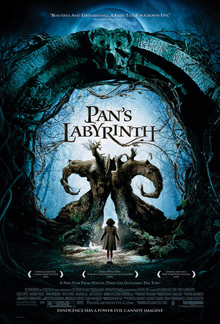
I saw the film "Pan's Labyrinth" in the theater last night. It is a beautiful, magical, tragic film and I loved it without hesitation.
The cinematography (by Guillermo Navarro) was stunning. I knew this would be a visual treat as soon as I saw that early scene where Ofelia puts the stone back in the statue and the insect/fairy flies around her. I adored the color pallete the gorgeous way he shot both banquet scenes.
The acting was top notch - no Hollywood stars and pitch-perfect casting. Ofeliea was amazing. Mercedes was amazing. The mother was amazing. The Captain was amazing. Doug Jones was freaking terrifying.
The storyline was truly inspired and I'm still writhing in jealous agony. I found the juxtaposition of the Spanish civil war elements with the fantastic themes to be entirely brilliant and struggle to imagine how he managed to come up with the idea.
This morning, I spent some time thinking about the ideas in Del Toro's film that overlap onto the book I'm trying to write. I thought about it for a while and kept uncovering more parallels and shared influences.
First, the old order of things and the transition into something new.. Pan's Labyrinth took place at a time of great change in Spain. The labyrinth/portal was the last of it's kind. Pan himself is an old god and a symbol of transition - half-man, half-goat beastie. Ofelia was a girl on the edge of puberty. Birth and lots of death. The chalk doorways, the faun's presence in Ofelia's bedroom, the blurring of the real world with the magical.
Additionally, Pan is a deity of the chthonian order - an older classification representing earth (Ofelia said he smelled of earth, remember?), the underworld and the grave. Chthonian deities fell eventually to the Olympian gods that inhabited the heavens. Recall that at the center of labyrinth was not some ivory tower, aspiring to the heights and godhood. It was a dark, scary cavity in the earth, as most chthonic altars were represented.
The labyrinth itself is an age old theme that pops up everywhere in ancient mythology (from Crete to Hecate's own labyrinth!). Some choose to interpret it as a symbol of man's ability to control his fate. I love this idea, particularly as it relates to fantasy fiction. Writers like China Mieville have done a great job of calling this to the readers attention - destiny is bullshit, there is no such thing as fate. We are the choices we make. I see this as a critical theme in the book I'm working on.
A certain bookishness exists and is celebrated in the Pan's Labyrinth. I admire and hope to incorporate this same feeling into my project. I love the idea of the escapist bookworm, eager to experience mystery and wonder...then stumbling into some of their own.